
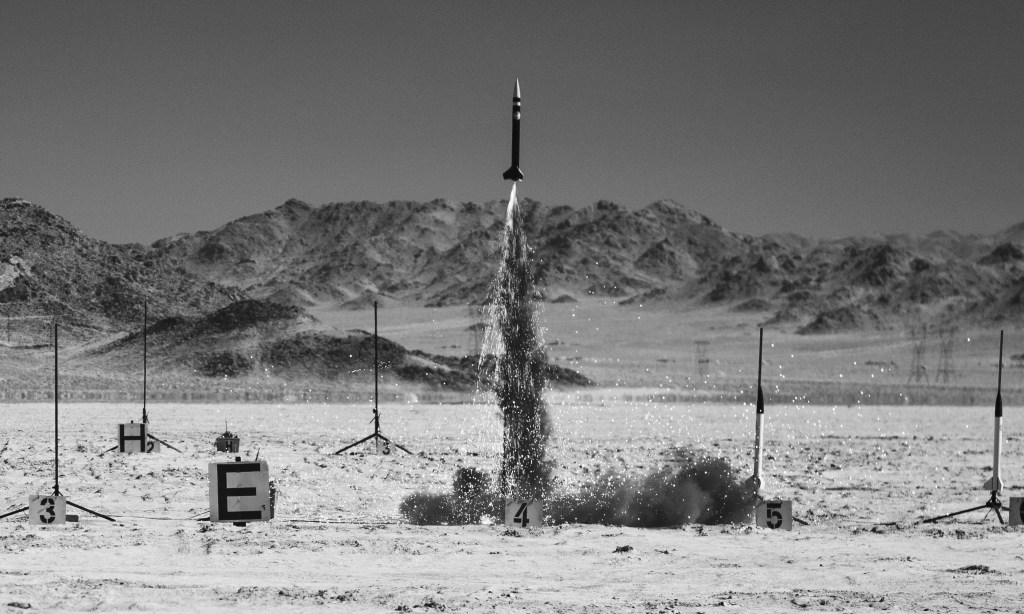
Understanding the relationship between center of gravity and center of pressure is not just an academic exercise, it is the foundation of stable flight for anything moving through the atmosphere, whether it is a rocket, an airplane, a dart, or even a sandal. In fact, understanding these forces was a huge factor in the first 3 team members passing the high powered rocketry certification flight on their first attempt. But what do these terms mean? How can we use them to help us?
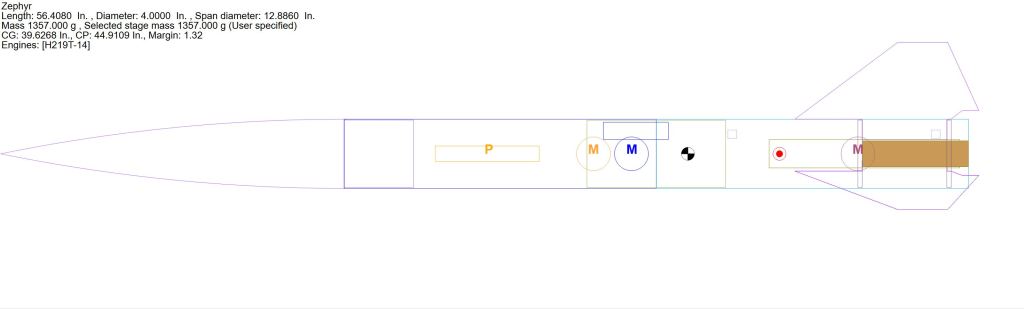
Figure 1: Rocket Body Simulation
When amateur rocketeers build high-powered rockets, they are required to do a simulation to optimize performance for the safety of the launch space and audience. These simulations include showing the rocket’s center of gravity and center of pressure.
If you have ever dropped something, it may spin and tumble around before crashing into the ground. And if you look closely enough, the object tends to spin around a spot in its body. It is more noticeable if the dropped item has an unequal weight distribution and it is thin and long, such as a baseball bat or an axe.
Those examples will tend to spin around its center of gravity, the point in the object considered to be the median or average of all its weight added up and divided in two across all dimensions (length, width, height; or the x, y, z dimensions).
If you were to mathematically solve the magnitude of gravitational pull at which each little piece of the object and its small portion of mass experiences, you would find that the math can be simplified down to going to that singular point of the average mass, calculating the total mass of the object, and multiplying by the gravitational acceleration of the Earth’s pull (~9.81 m/s^2 at sea level). This is what we would consider the “weight” of an object, and it is simply considered to be acted on the object’s center of gravity.
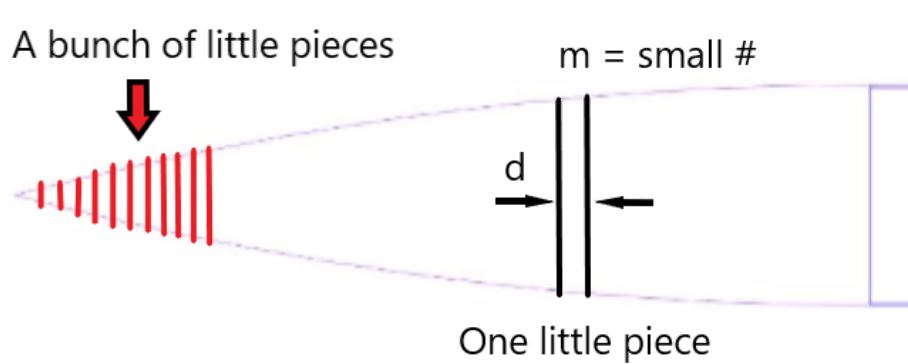
Figure 2: Little Pieces Added Up
Each small piece of a rocket has a small distance and a small amount of mass. If you sum up all of the masses and their distance (sum = mass*length of 1 piece + mass*length of 1 other piece +….) and then divide that entire sum with the total mass of the entire rocket, you will get the center of mass. Your rocket simulation can do this for you.
Note: Center of mass and center of gravity are interchangeable. It differs only in that the center of gravity calculation includes the constant gravitational acceleration across the object’s body. Since it is constant, the only difference is in numerical value, not position.
Similar enough to the shape of a baseball bat is a rocket; however, there are more forces acting on a flying object: air resistance. Unlike the (typical) unmoving, still air at the ground, the air high in the atmosphere is moving around quickly, which can push a rocket all around its body. The difference though is that the force of air cannot be simplified down to applying on a singular point of a body. That force is applied across the entire surface area, and we call that type of force “pressure”. We can feel that difference when we stick our arm out the car window, the air is hitting every single part of us somewhat evenly.
“Somewhat” because you can change whether those air particles slam into your hand or glide around it. If you have your palm facing the front towards the air or towards the front of your car, then the air resistance is strong and can push your hand back if you are not stabilizing your arm enough. But if you face your palm down to the ground, suddenly you do not have to work as hard to keep your arm straight. The slimmer profile of your hand means air is not slamming into a “wall” and abruptly stopping. Instead, the particles can tumble over or under your thumb and index finger and across your hand, and it keeps on moving.
Newton’s third law says for every action is an equal and opposite reaction. So the particles hitting your not-very-aerodynamic palm literally pushes off you, forcing your hand back. With your palm down, it no longer pushes off you as much as the surface area that it could slam into is a much smaller profile.
It was previously stated that the air resistance is a pressure which is not a singular point of force acting on an object but instead along the entire body. One would then assume you could not have a “center of pressure” akin to a “center of gravity”. To simplify, let us assume pressure acts uniformly across the rocket’s length. In reality, pressure varies with surface profile. We can assume there will be a singular point of an ‘average’, and realize the only change in pressure will be due to the profile of the rocket. The surface area that the air is hitting – similar to our hand out of the window – will affect how many air particles are hitting each area of the rocket body.
Therefore, the center of pressure can be simplified to the average of the surface area of the rocket profile. Because of a pointy aerodynamic nose cone in the front and the inclusion of multiple fins in the rear, one can assume that the average of the surface area is towards the rear of the rocket.
These concepts are important because forces that do not act on the center of gravity induce a spin or, in physics, a “moment” around said center of gravity. Because the collective force of pressure is acting on the center of pressure, which is not typically at the center of gravity, pressure will attempt to spin a rocket around. A terrifying result, but only if you do not appropriately place your centers.
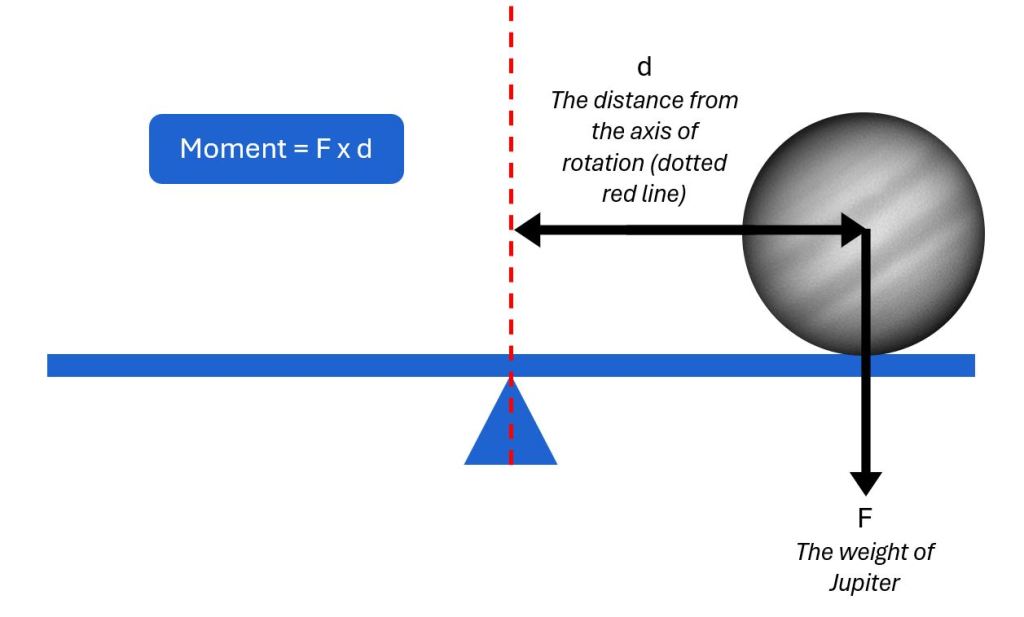
Figure 3: Moments
The fulcrum, or pivot point, of the seesaw can represent the center of gravity. The seesaw will rotate/spin around the pivot point, or fulcrum, due to Jupiter applying a force on the bar somewhere other than through the center of gravity.
Imagine a rocket that is flying upward through the atmosphere. Regardless of the location of the center of pressure, a wind gust hitting the side of the rocket will tilt the nose downward to the side, rotating around the center of gravity.
Now, put the center of pressure above the center of gravity, towards the nose cone. Besides the sidewards gusts, there are also air particles hitting down on the rocket on the nose cone from drag and gliding across the body towards the fins. The pressure force of the drag will continue to push down and spin the nose cone towards the ground, causing instability. This is not conducive to a good rocket launch.
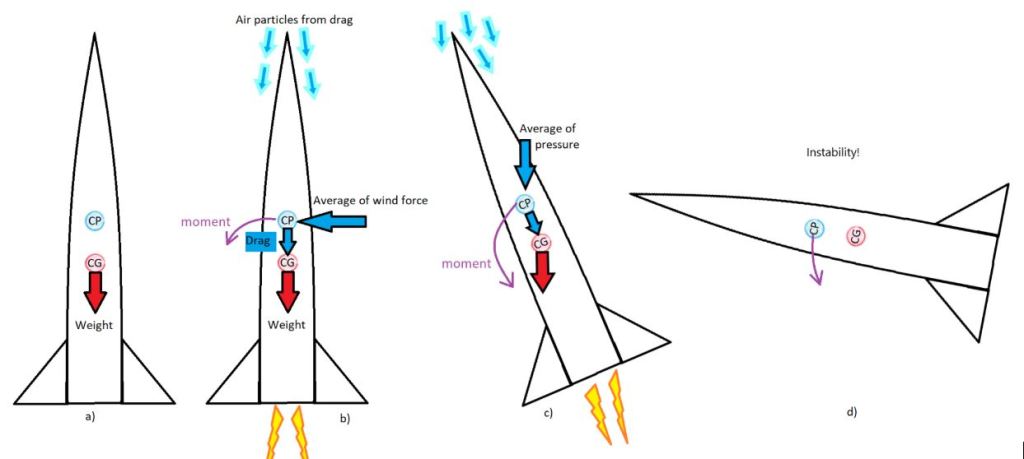
Figure 4 Instability in Rockets
The various ways air can apply force on a rocket can induce a spin. If the center of pressure is above the center of gravity, then the rocket is more likely to continue spinning the nose cone downwards. The moment, represented by the purple arrow, is a product of the force from “average of wind force/pressure”, not an additional applied force.
However, if the center of pressure is below the center of gravity, towards the fin, then the average of pressure forces can correct the rocket back to pointing straight up, acting as a stabilizing force.
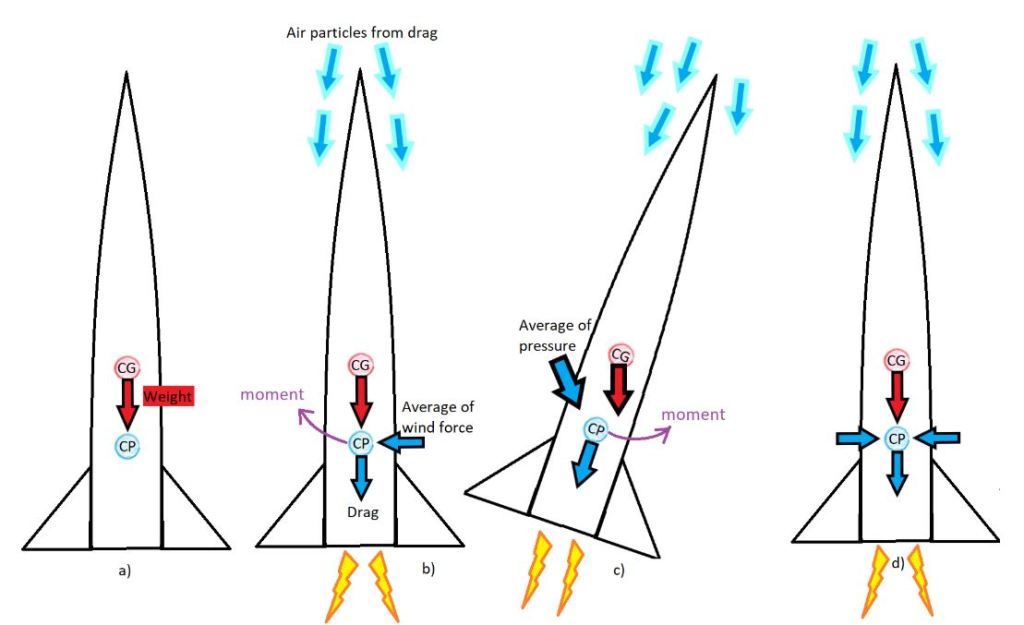
Figure 5 Stability in Rockets
If the center of pressure is below the center of gravity, then the spin is self-righting.
What questions do these concepts raise for you? Have you noticed the stabilizing effects of aerodynamic design in objects around you, perhaps when you put your hand out of a moving car and angle your hand just right? If you were designing a rocket or aircraft, how would you decide where to place the center of pressure relative to center of gravity, and what trade-offs might you accept? Share your thoughts or observations in the comments below.



Leave a Reply