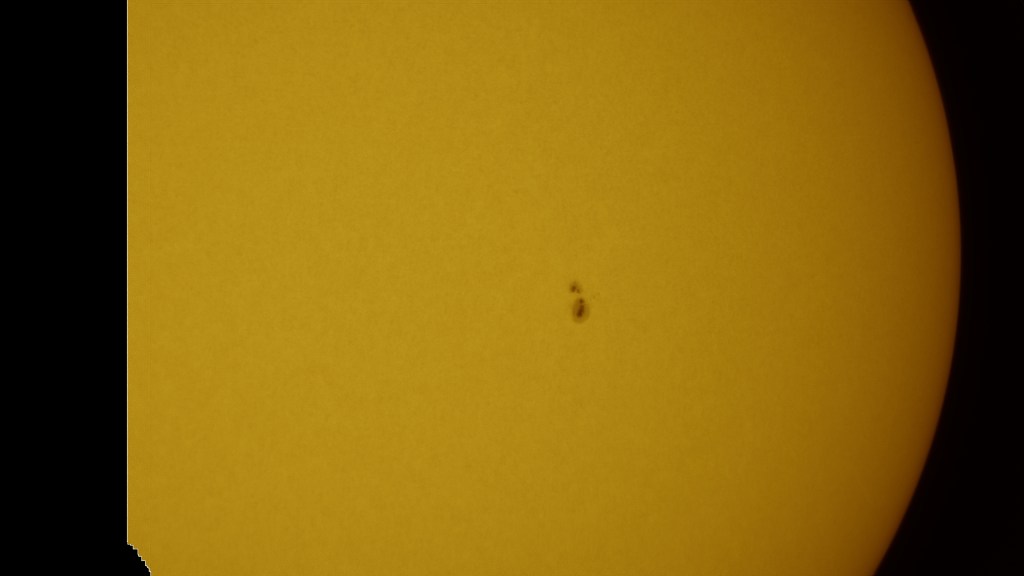
Welcome to our first astronomy article! While we figure out how to get our telescope dialed in for exoplanet research, we can still do some science with the imagery we do have! In this article we will focus on the Sun, our home star. Mind you these images were taken with a very thick filter meant for looking at the Sun. Please do not look at the sun without equipment meant for it!
With that very important warning out of the way, let us look at the first image from May 15, 2026. To appreciate the sheer scale of this image I have added several Earths to just put this into perspective, just under 78 of them!
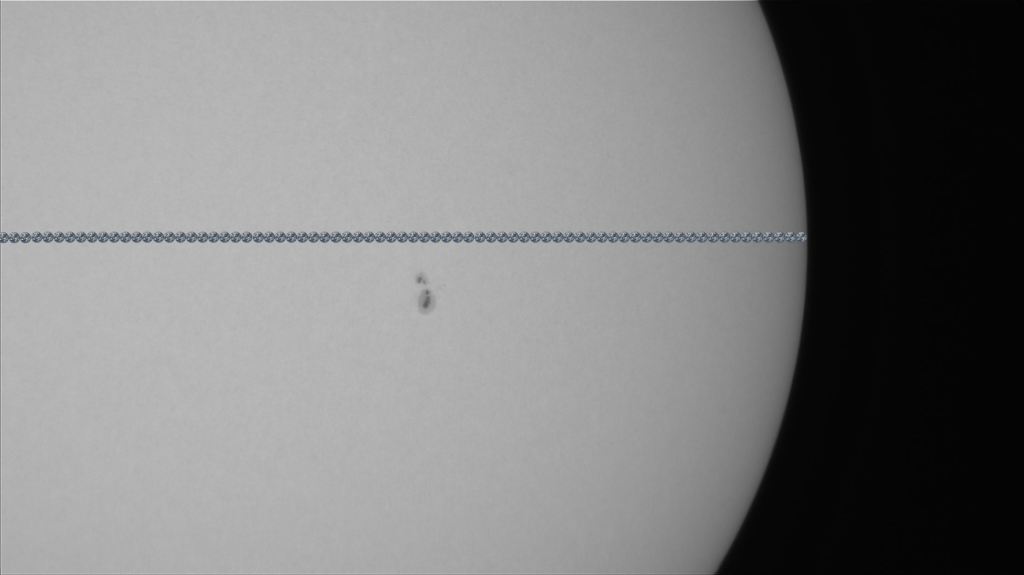
From this vantage point we can see that the Sun, in this image, is about ~618,228 miles wide! If you used those following modes of transportation it would take this long to get across this distance.
| Mode of Transportation (1) | Speed | Time |
| Walk | 3 mph | ~565 years |
| Bike | 17 mph | ~100 years |
| Highway Driving | 65 mph | ~26 years |
| Commercial Jet | 561 mph | ~3 years |
| International Space Station | 17,150 mph | ~36 hours |
| Fastest Human Speed (Apollo 10) | 24,791 mph | ~25 hours |
Zooming in you can see this dark spot. The larger of these “mere spots” is ~27,000 miles long and 21,000 wide. In other words, that’s about 3.5 Earths by 2.5 Earths! We will see more of these spots later but when this image was taken, this side of the sun had this relatively small one showing towards Earth.
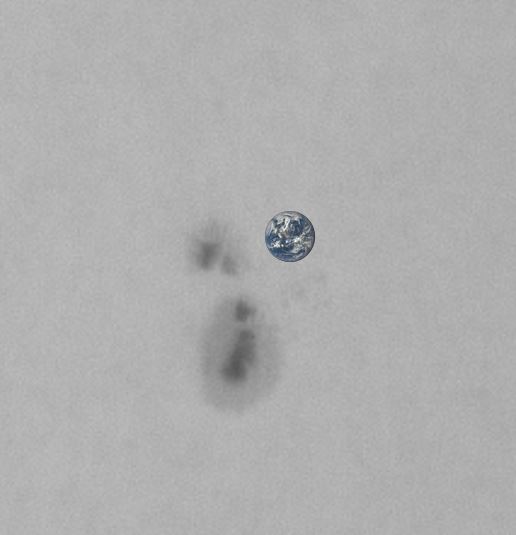
So what is a Sun spot? They are where the Sun’s magnetic field is concentrated in a smaller area than normal. When this happens, it causes this area to become relatively cooler (only 6,000F) than the surrounding area which is typically at 10,000F (2). The more there are, the more active the magnetic field is in that area. However, the Sun does have periods of high and low magnetic field activity that last 11 years. When activity is higher, there are more sunspots.
Perhaps in the future we will write a dedicated article to how sun spots work in greater detail but for now let us zoom in more.
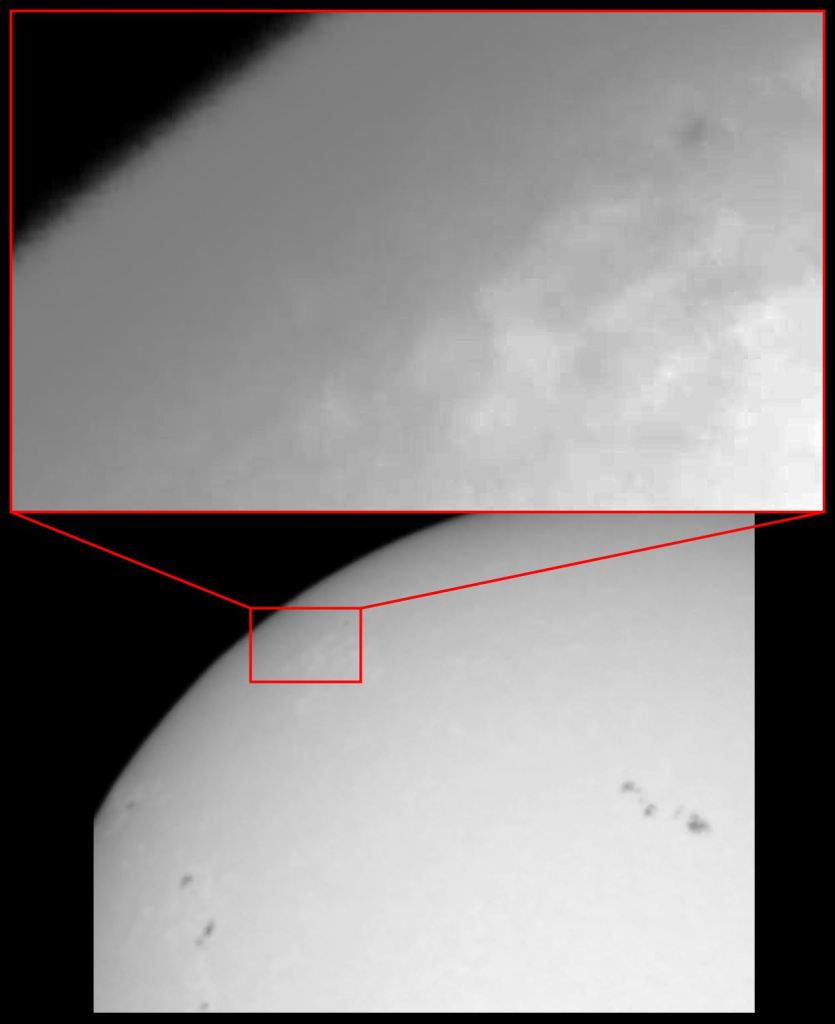
Above is a feature that is pretty hard to see and was not something we were planning on seeing given the type of solar filter used. For reference, we used a full spectrum aperture glass solar filter. If our educated guess is correct, these white patterns are granulations or convection cells on the surface of the Sun. You have likely seen smaller and much colder convection cells in your coffee, tea, or in my favorite example, miso soup. The cells are where relatively cool plasma sinks back down as hotter plasma rises.
Now that we’ve covered the sunspots, we spotted something rather mysterious, unidentified even. Can you spot it in these before and after images? Drag the divider and see if you can spot it.
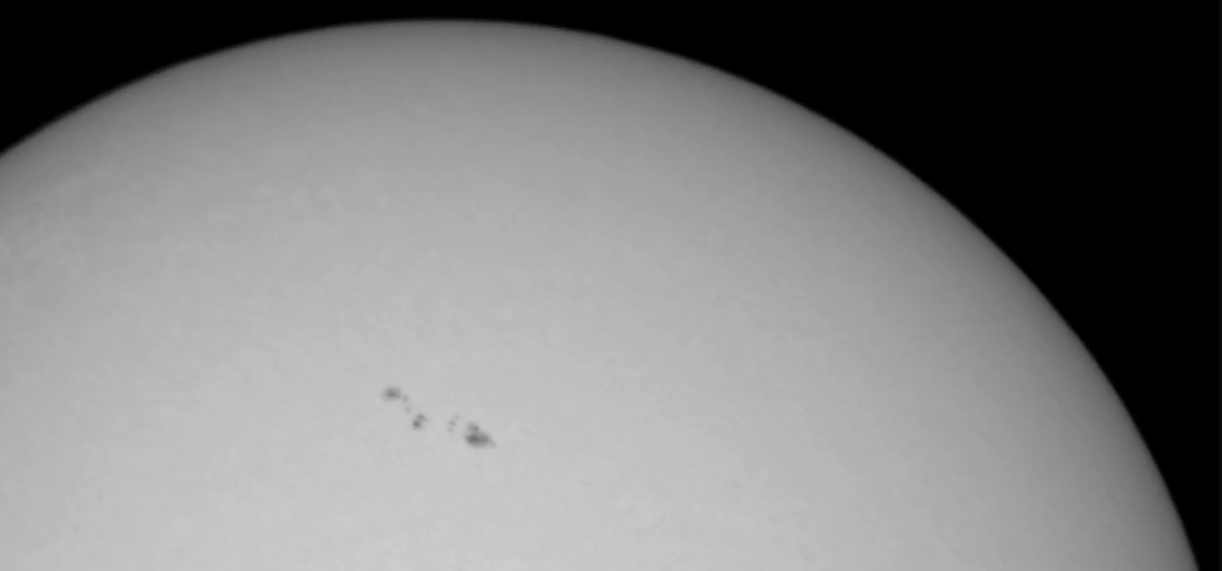
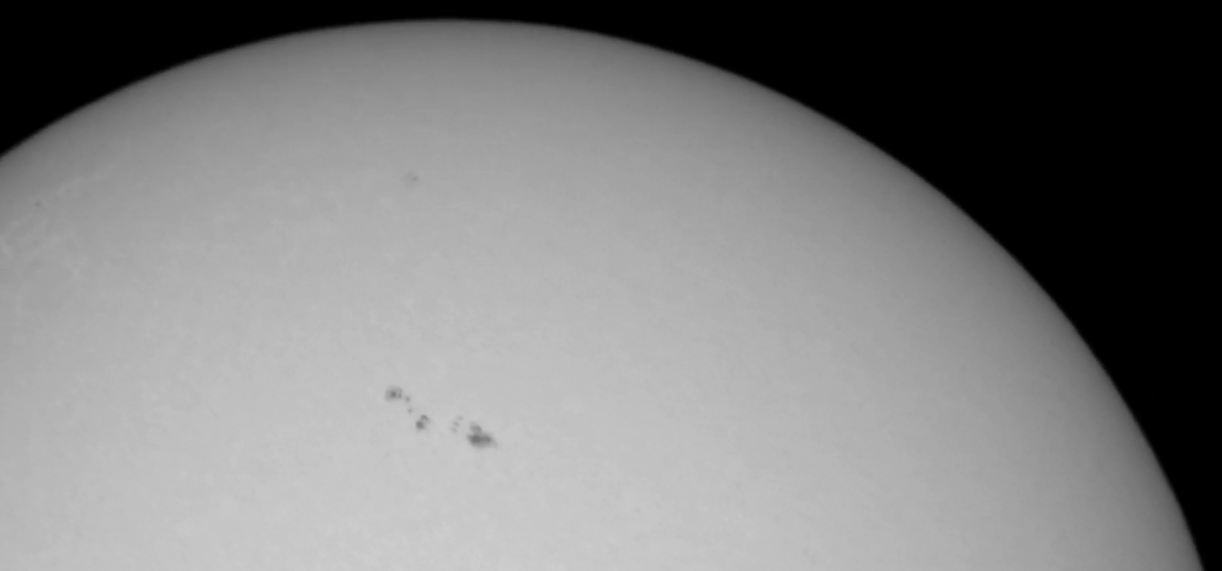
See it? While we’re not 100% certain, it is technically a UFO (No, not aliens! That will be its own article, we promise!) With that being said, given that we captured at least two instances of this in less than 2 minutes of video recording, plus its speed and trajectory, we are pretty sure it’s a satellite. Assuming it is Low Earth Orbit (LEO), the object is likely around 250-500 miles up (3). Assuming it be an object in LEO, like Starlink, you get these velocities, and compared to the average velocity of an object at that altitude:
| Object Altitude (miles) | Estimated Object Velocity (mph) | Average Orbital Speed (mph) (4) |
| 250 | 22,468 | 17,157 |
| 340 | 30,573 | 16,978 |
| 500 | 44,932 | 16,665 |
So yes, my calculations are off, but alas they are off the back of the napkin and there are A LOT of BIG assumptions baked in. My math also assumes a perfectly circular orbit above the equator which the object may actually have a more eccentric orbit and would 100% have higher inclination. Alas, we will save orbital mechanics for later, however, we are, at least in the same astronomical ball park!
Regardless, it is truly amazing what you can learn from just a handful of images and with the power of SCIENCE! What other science do you think we could do with images of the Sun? Do you also think it is a satellite? Why or why not? Comment below and let us science! You can also find the full video of the Sun below.
Sources
- What is the average speed of different modes of transportation? (n.d.-c). https://www.gigacalculator.com/articles/what-is-the-average-speed-of-different-modes-of-transportation/
- The surface of the Sun | Center for Science Education. (n.d.-b). https://scied.ucar.edu/learning-zone/sun-space-weather/surface-of-the-sun
- Starlink Satellites: Facts, tracking and impact on Astronomy | Space. Space.com. (n.d.). https://www.space.com/spacex-starlink-satellites.html
- Orbital Speed Calculator — velocity at any altitude | spaceodysseyhub. SpaceOdysseyHub. (n.d.). https://spaceodysseyhub.com/tools/orbital-calculator
- NASA. (n.d.-a). Sunspots – NASA science. https://science.nasa.gov/sun/sunspots/



Leave a Reply